
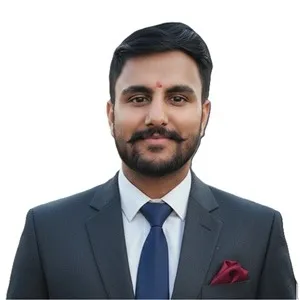

Salil Khajuria
Chandigarh/Online
Skills
About
Salil Khajuria is a committed Biology tutor offering both online and offline classes, with focused experience in NEET Biology and school-level Biology. With 1 year of teaching expe...
Salil Khajuria is a committed Biology tutor offering both online and offline classes, with focused experience in NEET Biology and school-level Biology. With 1 year of teaching experience, he works closely with students from Classes 8 to 12, including NEET aspirants and A Level / A & AS Level Biology learners, helping them build strong conceptual clarity and exam readiness.His teaching style is structured, student-friendly, and aligned with syllabus requirements, making Biology easier to understand and retain.Qualifications SummaryM.Sc.Polytechnic DiplomaB.Tech / B.E.This strong academic background equips Salil with subject depth, analytical thinking, and the ability to explain complex biological concepts clearly.Experience OverviewOver the past year, Salil Khajuria has guided students preparing for school exams, NEET Biology, and international curricula. His focus remains on strengthening fundamentals, understanding NCERT concepts, and applying knowledge effectively in exams through regular practice and revision.
Salil Khajuria
Chandigarh/Online
Skills :
★
★
★
★
★
Salil Khajuria is a committed Biology tutor offering both online and offline classes, with focused experience in NEET Biology and school-level Biology. With 1 year of teaching expe...
Salil Khajuria is a committed Biology tutor offering both online and offline classes, with focused experience in NEET Biology and school-level Biology. With 1 year of teaching experience, he works closely with students from Classes 8 to 12, including NEET aspirants and A Level / A & AS Level Biology learners, helping them build strong conceptual clarity and exam readiness.His teaching style is structured, student-friendly, and aligned with syllabus requirements, making Biology easier to understand and retain.Qualifications SummaryM.Sc.Polytechnic DiplomaB.Tech / B.E.This strong academic background equips Salil with subject depth, analytical thinking, and the ability to explain complex biological concepts clearly.Experience OverviewOver the past year, Salil Khajuria has guided students preparing for school exams, NEET Biology, and international curricula. His focus remains on strengthening fundamentals, understanding NCERT concepts, and applying knowledge effectively in exams through regular practice and revision.
FindMyGuru is a tutor discovery platform that helps students find and connect with experienced tutors and institutes across a wide range of subjects and skills. Students can explore tutor profiles, compare expertise, and contact tutors directly for online or in-person learning.FindMyGuru facilitates discovery and connections between students and tutors or institutes. All classes and learning arrangements are handled directly between students and the respective tutors or institutes
Courses by: Salil Khajuria
NEET Biology Online Coaching – NCERT & Advanced Prep by Salil Khajuria
Basic part (Foundations)
Basic: NCERT + Concepts + Diagrams
Diversity in living world: classification, 5 kingdoms, viruses, monera, protista, fungi, plant groups, animal phyla.
Structural organisation: morphology of flowering plants, anatomy of plants, animal tissues and cockroach/frog examples.
Cell and biomolecules: cell structure, organelles, membrane transport, biomolecules, cell cycle and division.
Plant physiology: water and mineral transport, photosynthesis, respiration, plant growth and hormones.
Human physiology: digestion, respiration, circulation, excretion, locomotion, neural and endocrine control.
Reproduction basics: reproduction in organisms, sexual reproduction in flowering plants, human reproduction.
Genetics basics: Mendel, laws of inheritance, monohybrid/dihybrid crosses, pedigree simple numericals.
Ecology basics: ecosystem, food chains, biogeochemical cycles, population and community concepts.
Advance part (High‑yield NEET)
.Advanced genetics & evolution: linkage, recombination, gene mapping idea, molecular basis of inheritance, Hardy–Weinberg, evolutionary mechanisms.
Reproductive health & human health and disease: contraception, STDs, immunity, vaccines, allergies, cancer, AIDS.
Biotechnology: tools (restriction enzymes, vectors, PCR), cloning, GM crops, insulin, gene therapy, DNA fingerprinting.
Advanced ecology & environment: population interactions, succession, biodiversity, conservation, pollution and environmental issues.
High‑level plant & human physiology numericals and NEET‑level MCQ tricks from PYQs.
6 days a week: 5 days focused concept classes (1 hour live teaching with zero distraction), followed by 1 hour of Daily Practice Problems, doubt‑solving and quick revision of the latest topics and previous two classes; and 1 day full‑syllabus test with detailed discussion. Every session builds strong concepts, intensive practice and complete clarity before moving to the next unit.
Human Physiology Mastery – NEET & Class 11–12 Biology Online Course by Salil Khajuria
Body Fluids and Circulation
Definition of body fluids; types: intracellular fluid, extracellular fluid, blood, lymph.
Blood: composition (plasma, formed elements); functions of RBC, WBC, platelets.
Plasma: water, proteins (albumin, globulin, fibrinogen), ions, nutrients, wastes.
Blood groups: ABO system (antigens, antibodies), Rh factor, erythroblastosis fetalis (concept only).
Blood coagulation: clotting factors, role of platelets, basic cascade idea (prothrombin → thrombin → fibrin).
Lymph: composition, formation from tissue fluid, functions (drainage, absorption of fats, immunity).
Human heart: position, size, external features; chambers, valves, major vessels (aorta, venae cavae, pulmonary artery/vein).
Internal circulation: pulmonary vs systemic, oxygenated vs deoxygenated paths.
Cardiac cycle: phases – atrial systole, ventricular systole, joint diastole; concept of lub–dub sounds.
Heartbeat: myogenic nature, nodal tissue (SA node, AV node, bundle of His, Purkinje fibres), pacemaker.
Cardiac output: stroke volume × heart rate; normal values (concept level).
Blood vessels: artery vs vein vs capillary (structure and function).
Double circulation: pulmonary + systemic circulation; significance in endothermy.
Regulation of cardiac activity: role of autonomic nervous system (sympathetic, parasympathetic) and hormones (adrenaline).
ECG: basic waves (P, QRS, T) and what they represent (atrial depolarisation, ventricular depolarisation, ventricular repolarisation).
Disorders: hypertension, coronary artery disease, angina pectoris, heart failure (basic definition and cause lines).
Excretory Products and Their Elimination
Need for excretion; nitrogenous wastes: ammonia, urea, uric acid.
Types of animals: ammonotelic, ureotelic, uricotelic (examples).
Human excretory system: kidneys, ureters, urinary bladder, urethra – gross anatomy.
Nephron: structure – Bowman’s capsule, glomerulus, PCT, loop of Henle, DCT, collecting duct.
Urine formation steps:
Ultrafiltration at glomerulus.
Selective reabsorption in PCT, loop, DCT.
Tubular secretion in PCT, DCT, collecting duct.
Counter-current mechanism: loop of Henle and vasa recta in urine concentration (concept only).
Osmoregulation: role of kidney in water and salt balance.
Regulation of kidney function:
ADH and water reabsorption.
Renin–angiotensin–aldosterone system (RAAS) in BP and Na⁺ balance (basic idea).
Atrial natriuretic factor (ANF) opposing RAAS.
Other excretory organs: lungs (CO₂), liver (bile pigments), skin (sweat), intestine.
Disorders: uraemia, renal failure, renal calculi, nephritis; dialysis principle.
Breathing and Exchange of Gases
Differences between breathing and respiration (external vs cellular).
Respiratory organs in animals (only recall): gills, tracheae, skin, lungs (examples).
Human respiratory system anatomy: nostrils, nasal cavity, pharynx, larynx, trachea, bronchi, bronchioles, alveoli.
Alveolus: thin walls, rich capillary network, large surface area.
Mechanism of breathing:
Inspiration: diaphragm contraction, rib cage expansion, thoracic volume increase, pressure drop.
Expiration: diaphragm relaxation, rib cage moving down, thoracic volume decrease, pressure rise.
Lung volumes and capacities: tidal volume, inspiratory reserve, expiratory reserve, vital capacity, total lung capacity (values conceptually).
Exchange of gases:
At lungs: diffusion of O₂ into blood and CO₂ out, based on partial pressure gradients.
At tissues: reverse diffusion between blood and cells.
Transport of gases:
O₂: oxyhaemoglobin, oxygen–haemoglobin dissociation curve; effect of pO₂, pCO₂, temperature, pH.
CO₂: dissolved, bicarbonate, carbamino-haemoglobin (relative percentages).
Regulation of respiration: respiratory centre in medulla and pons; role of CO₂/H⁺ concentration.
Disorders: asthma, emphysema, occupational lung diseases (basic cause and effect).
Locomotion and Movement
Movement vs locomotion; biological significance.
Types of movement: ciliary, flagellar, muscular (examples for each).
Skeletal muscle structure: muscle → fascicles → muscle fibres → myofibrils → sarcomere.
Contractile proteins: actin, myosin; A band, I band, Z line, H zone.
Mechanism of muscle contraction (sliding filament theory):
Role of Ca²⁺ and troponin–tropomyosin complex.
Cross-bridge formation, power stroke, ATP requirement.
Types of muscle: skeletal, smooth, cardiac – structure and control (voluntary/involuntary).
Skeletal system: axial vs appendicular skeleton (major bones and functions).
Joints: fibrous, cartilaginous, synovial; examples and basic features.
Disorders: myasthenia gravis, tetany, muscular dystrophy, arthritis, osteoporosis, gout (one line description each).
Neural Control and Coordination
Need for control and coordination; neural vs hormonal control.
Neuron: structure – cell body, dendrites, axon; types – sensory, motor, interneuron.
Resting membrane potential: ionic distribution (Na⁺/K⁺) and role of Na⁺–K⁺ pump.
Action potential: depolarisation, repolarisation, hyperpolarisation (concept-only graph).
Conduction of nerve impulse:
Along non-myelinated fibres (continuous).
Along myelinated fibres (saltatory conduction; nodes of Ranvier).
Synapse: structure (pre-, post-synaptic membrane, synaptic cleft).
Synaptic transmission: chemical synapse, neurotransmitter release (e.g., acetylcholine); steps of transmission.
Organisation of human nervous system:
CNS: brain and spinal cord – very brief subdivisions (forebrain, midbrain, hindbrain functions).
PNS: cranial and spinal nerves.
Autonomic NS: sympathetic vs parasympathetic (effects examples).
(Note: Reflex action and detailed sense organs content is reduced/removed in new NEET syllabus; keep as minimal conceptual link if you mention.)
Chemical Coordination and Integration (Endocrine System)
Endocrine vs exocrine glands; types of hormones (peptide, steroid, amine – basic).
General properties of hormones: act in low concentration, specificity, feedback regulation.
Hypothalamus: releasing and inhibiting hormones; link between nervous and endocrine system.
Pituitary gland:
Anterior lobe hormones: GH, TSH, ACTH, FSH, LH, Prolactin – basic functions.
Posterior lobe: ADH, oxytocin – functions.
Pineal gland: melatonin, role in circadian rhythm (concept).
Thyroid gland: thyroxine (T₄/T₃) in metabolism and growth; calcitonin in Ca²⁺ regulation.
Parathyroid glands: PTH, role in Ca²⁺ and phosphate homeostasis.
Adrenal gland:
Adrenal cortex: mineralocorticoids (aldosterone), glucocorticoids (cortisol), sex corticoids (basic actions).
Adrenal medulla: adrenaline, noradrenaline – fight or flight responses.
Pancreas (Islets of Langerhans): insulin, glucagon; regulation of blood glucose.
Gonads:
Testes: testosterone – role in male secondary characters, spermatogenesis.
Ovaries: estrogen, progesterone – female cycle, pregnancy, secondary characters.
Mechanism of hormone action: receptor concept (membrane vs intracellular), signal generation (only elementary idea).
Disorders (hypo/hyper): dwarfism, gigantism, acromegaly, cretinism, myxoedema, simple goitre, exophthalmic goitre, diabetes mellitus, Addison’s disease (one-line cause/effect).